
How to Reduce Vehicle Queues at a Parking Entrance
Release time:
2026-11-05
Conclusion: entrance queues are usually caused by the slowest step in the whole vehicle journey, not by the barrier alone. Measure authorisation, payment and clearance times first; then improve signs and lane layout, add reliable ANPR/LPR or RFID, match the barrier duty cycle to demand and keep detection and maintenance under review.
Vehicle queues at a car park entrance can frustrate drivers, delay staff and visitors, create congestion on nearby roads and place extra pressure on parking teams. The cause is not always a slow boom barrier. Queues often develop because several small delays occur together: drivers searching for tickets or access cards, unclear entry instructions, slow payment confirmation, unreliable number plate reads, poor lane layout or a barrier system that is not suited to the traffic volume.
A practical queue-reduction plan should look at the complete vehicle journey, from approaching the site to passing the barrier and clearing the detection zone. This guide explains how to identify bottlenecks and combine suitable boom barriers, ANPR/LPR, RFID, vehicle detection and operating procedures to improve traffic flow. BAROXON Europe's published range includes boom barriers, high-speed barriers, ALPR/LPR car plate systems, automatic RFID boom barriers and radar sensors for vehicle access-control projects.
1. Identify Where the Queue Actually Forms
Before changing equipment, observe the entrance during both normal operation and the busiest periods. Record where vehicles begin to slow down, how long they wait, whether drivers stop to search for credentials, and whether the queue clears immediately after the barrier opens. A queue that forms before the reader may indicate poor signage or a difficult approach. A queue that remains under the barrier may point to slow authorisation, payment processing or an unsuitable barrier cycle.
Measure the complete transaction rather than looking only at the barrier's advertised opening time. Useful observations include arrival rate, average authorisation time, payment confirmation time, barrier opening and closing time, the time each vehicle takes to clear the lane, and the number of manual interventions. Compare the same measures across several peak periods so that one unusual event does not distort the diagnosis.
A simple queue log can reveal whether the main constraint is access identification, payment, equipment movement, driver behaviour or site geometry. Fix the dominant bottleneck first; upgrading a fast barrier will not solve a queue caused by a slow payment terminal or unclear entry instructions.
2. Improve the Approach Lane and Entry Layout
Drivers should be able to understand where to enter, where to stop and which access method to use before they reach the barrier. Use clear signs for residents, visitors, members, deliveries and pay-on-entry users where these groups follow different procedures. Place signs and access readers where drivers can see and reach them without making sudden manoeuvres or reversing into the traffic behind.
Keep the approach lane wide and straight enough for the expected vehicle types. Avoid placing a ticket machine, intercom, payment terminal or reader where a driver must stop across a turning path. Check visibility around bends, walls, columns and landscaping. Where the site has separate entry and exit flows, make the lane markings and signs easy to distinguish.
For sites with frequent peaks, assess whether separate lanes are justified for pre-authorised users, visitors or commercial vehicles. A dedicated lane can reduce interaction between different transaction types, but it should only be introduced where the available space, traffic pattern and operating policy support it. Poorly planned lane splitting can create extra merging points and make congestion worse.
3. Use ANPR/LPR to Reduce Manual Credential Handling
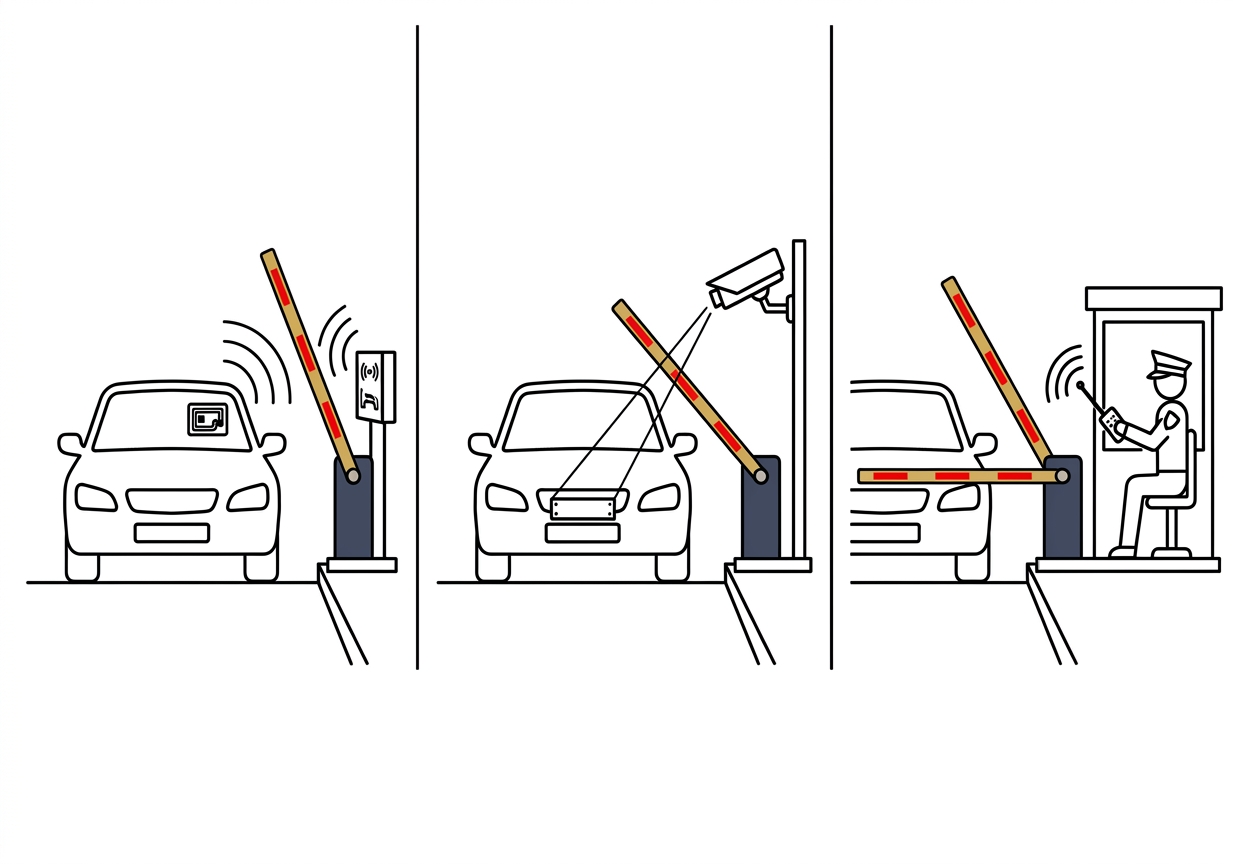
Automatic Number Plate Recognition (ANPR), also called License Plate Recognition (LPR), can identify an authorised vehicle by reading its registration plate. When a vehicle's plate is registered in the parking-management system and the access rules are satisfied, the system can send an opening command to the barrier without requiring the driver to find a ticket or present a card. This can make entry more convenient for staff parking, registered residents, fleet vehicles and other pre-authorised users.
BAROXON Europe lists ALPR/LPR car plate systems and parking-management software with camera-based vehicle access control. For a project, confirm the complete scope: camera, mounting position, lighting, controller interface, whitelist or permission database, network connection, software configuration and commissioning. Recognition performance depends on the camera, plate condition, vehicle speed, viewing angle, lighting, weather and local number plate formats, so the installer should test the system at the actual entrance.
ANPR is not automatically the best choice for every vehicle. Dirty, damaged, obscured or non-standard plates may require an alternative verification method. Provide a clearly explained fallback, such as an intercom, staffed assistance point or approved credential reader, so that one failed recognition does not hold up the entire lane.
4. Use RFID for Frequent and Known Users
RFID cards, tags or compatible long-range readers can speed up access for regular users who have been issued valid credentials. They are particularly useful where staff, residents, permit holders or fleet vehicles enter repeatedly. A properly positioned reader allows a driver to present a card or a vehicle-mounted tag without leaving the vehicle, while the access-control system checks the credential and triggers the barrier when permission is granted.
RFID and ANPR solve related but different problems. RFID confirms possession of an assigned credential, while ANPR checks the vehicle registration plate against an authorised list. A site may use one method or combine both, depending on its security policy, user groups and operating budget. Avoid asking every driver to complete multiple checks when one reliable authorisation method is sufficient.
For a mixed-use car park, consider separate rules for registered users and occasional visitors. Regular users may use RFID or ANPR, while visitors follow a clearly signposted intercom, QR code, ticket or reception process. The goal is to make each user journey predictable and to prevent visitor enquiries from blocking the regular-user lane.
5. Select a Boom Barrier That Matches Traffic Demand
A barrier should be selected according to lane width, boom-arm length, vehicle volume, operating frequency, safety requirements and the available space. BAROXON Europe's published product categories include standard boom barriers and high-speed barrier gates, with straight, folding and fence-style arm options shown across its product information. A folding arm may be appropriate where overhead clearance is restricted; a straight arm may suit a conventional open approach. The correct choice must be confirmed against the site drawing and the exact model.
For a busy entrance, compare the complete operating cycle rather than the opening time alone. The barrier must raise, remain open long enough for the vehicle to pass, detect that the lane is clear and close safely before the next vehicle proceeds. A very fast opening movement does not improve throughput if the authorisation process is slow or vehicles are following too closely.
Check the quoted model's permitted duty cycle, motor configuration, arm length, opening and closing settings, protection rating and environmental limits. BAROXON's published LPR barrier product information lists different motor and speed configurations, arm types and protection options; these are model- and configuration-dependent, not universal specifications for every barrier. Ask for the current datasheet and a written confirmation of the configuration recommended for the site's expected peak traffic.
6. Coordinate Vehicle Detection and Safety Devices
Vehicle detection helps the controller understand whether a vehicle is approaching, passing through or still beneath the boom arm. Depending on the installation, suitable devices may include induction loops, photoelectric sensors or radar detection. Correct positioning and configuration can help prevent the arm from closing onto a vehicle and can reduce unnecessary barrier movements caused by poor detection.
Safety must not be sacrificed to shorten queues. Confirm the required anti-collision or auto-reverse behaviour, loop or radar interfaces, photoelectric protection where specified, emergency manual release and safe response during power interruption. The exact arrangement should follow the risk assessment, equipment instructions and applicable local requirements. Have the installer test real vehicle scenarios before the entrance is returned to service.
A detector that is too close to the barrier, poorly calibrated or affected by metal structures may create false triggers or missed detections. Include sensor placement, sensitivity settings, cable routing and commissioning tests in the installation plan. Keep the detection zone clear of parked vehicles and avoid allowing the queue to block the exit side of the barrier.
7. Streamline Payment and Visitor Authorisation
At paid car parks, payment processing can be a major source of delay. Review whether drivers must stop at the entrance to collect a ticket, scan a code, speak to an attendant or resolve a payment issue. Where the operating model permits, consider pre-booking, contactless payment, pay-on-foot terminals, online validation or payment linked to the vehicle registration. The best arrangement depends on the tariff model, user experience and the parking-management platform.
For visitors, make the authorisation process clear before they arrive. Hosts can pre-register a visitor's number plate or issue a temporary access code where the system supports it. Delivery drivers and contractors may need a separate process with defined time windows. Clear instructions reduce the number of drivers who stop at the barrier to telephone a contact or ask for directions.
Provide a fallback for failed payments, expired permits and unrecognised plates. A staffed help point or intercom should be positioned so that a driver needing assistance does not block the main flow for everyone else. Record the reason for each manual override; repeated cases may reveal a payment-interface problem, an outdated user database or unclear instructions.
8. Manage Peak Periods and Prevent Queue Spillback
A queue becomes a wider site-management problem when it extends beyond the entrance and blocks a public road, footway, cycle route or neighbouring property. Estimate the space available for vehicles to wait inside the site and identify the point at which the queue would spill back onto the public highway. If the internal storage space is limited, consider pre-arrival authorisation, staff scheduling, visitor time slots or temporary traffic marshals during exceptional peaks.
For business parks, logistics facilities and multi-tenant properties, coordinate access schedules with regular users. Where practical, spread deliveries and contractor arrivals across agreed time windows. Use clear signs and temporary lane guidance when an incident, roadworks or equipment maintenance changes the normal traffic pattern.
Do not allow a queue to block emergency access, pedestrian crossings or the exit route. The site traffic plan should define who can intervene, how drivers are redirected and how the barrier can be placed in a safe operating mode if the access-control system fails. Any temporary manual operation must preserve the site's safety controls.
9. Integrate the Barrier with a Reliable Parking Management System
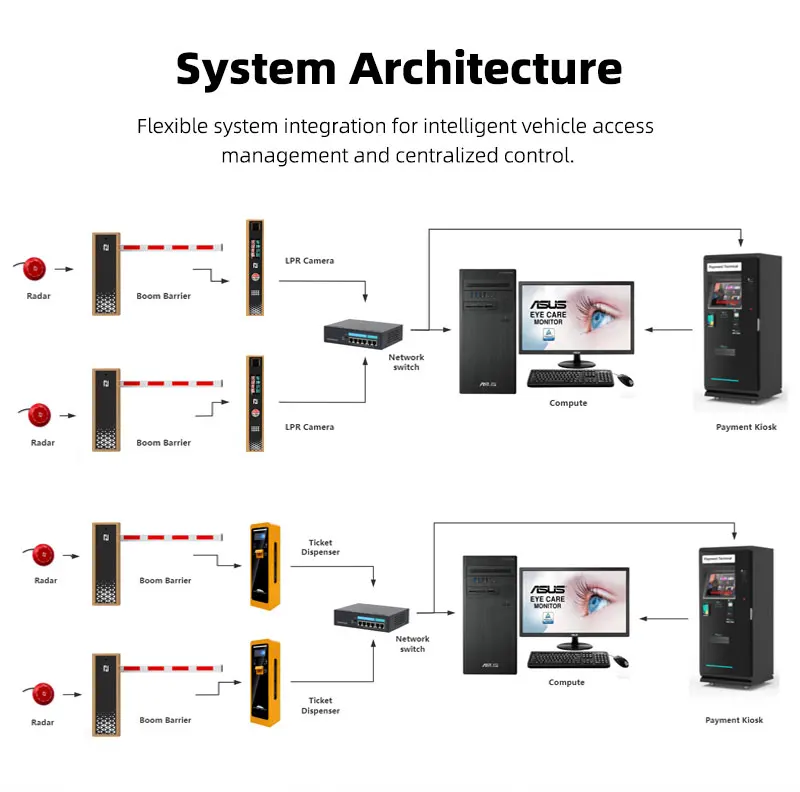
A barrier is only one part of the entrance process. The reader or camera, controller, parking software, payment service, network and vehicle detectors must exchange information reliably. Before procurement, ask the supplier or integrator to map the complete transaction: vehicle detected, credential or plate checked, payment or permit validated, opening command sent, vehicle passage confirmed and barrier safely closed.
BAROXON Europe publishes barrier products alongside RFID access, ALPR/LPR vehicle recognition, parking-management software and radar sensor categories. For a combined solution, confirm which components are included, which interfaces are supported and who is responsible for software configuration, network setup, third-party integration and on-site testing. Do not assume that every third-party platform is compatible without a documented interface check.
Plan for failure as well as normal operation. Confirm what happens if the network is unavailable, the camera cannot read a plate, the payment service is offline or the controller loses power. Depending on the site policy, options may include local credential records, an intercom, staffed assistance or a documented manual procedure. Test these scenarios before handover and make sure operators know how to respond.
10. Maintain Equipment and Monitor Queue Performance
A barrier that is poorly maintained can become an intermittent bottleneck. Include the boom arm, cabinet, drive mechanism, controller, safety sensors, loops, radar, reader or camera and network connections in the maintenance schedule. Check for loose fixings, damaged cables, misaligned sensors, water ingress, worn components and changes to the approach lane. Follow the manufacturer's maintenance instructions and isolate equipment safely before service work.
Track a small set of performance indicators after changes are made: average vehicle waiting time, peak queue length, successful first-pass recognition rate, manual override frequency, barrier fault events and time taken to clear an incident. Compare the results with the original baseline. If the queue remains long, revisit the transaction steps and arrival pattern rather than assuming that a faster barrier is the only remaining solution.
11. Practical Queue-Reduction Checklist
| Area | What to review | Expected benefit |
|---|
| Queue diagnosis | Measure arrival rate, authorisation time and vehicle clearance time | Identifies the real bottleneck |
|---|
| Lane layout | Improve signs, visibility, stopping position and lane separation | Reduces hesitation and conflicting movements |
|---|
| ANPR/LPR | Register authorised plates and test camera performance on site | Reduces manual credential handling |
|---|
| RFID | Provide convenient access for regular users | Speeds up repeat-user entry |
|---|
| Barrier selection | Match cycle time, arm length and duty rating to demand | Avoids equipment-related delays |
|---|
| Vehicle detection | Check loops, radar and safety sensors | Supports safe and consistent operation |
|---|
| Payment and visitors | Simplify payment and pre-authorise visitors | Reduces transaction delays |
|---|
| Peak management | Plan for queue storage and exceptional traffic | Helps prevent spillback |
|---|
| Integration | Test the full access-control sequence and fallback modes | Reduces system hand-off failures |
|---|
| Maintenance | Inspect equipment and review performance indicators | Reduces avoidable downtime |
|---|
Frequently Asked Questions
What is the quickest way to reduce queues at a parking entrance?
Start by identifying the slowest step in the vehicle journey. Clear signs, pre-authorised access, reliable ANPR/LPR or RFID identification and a suitable barrier configuration can reduce avoidable stops. If payment or visitor approval is the main delay, address that process before replacing the barrier.
Does ANPR reduce waiting time at a car park entrance?
ANPR can reduce the need for drivers to present tickets or cards when their number plates are registered and the access rules are configured correctly. Its real-world benefit depends on camera positioning, plate visibility, lighting, vehicle speed, software response and a workable fallback for unsuccessful reads.
Is RFID or ANPR better for busy parking facilities?
Neither is universally better. RFID is useful for known users with assigned cards or tags, while ANPR can identify registered vehicles without requiring a physical credential to be presented. Some sites combine both methods to serve different user groups. Choose according to access policy, traffic pattern, privacy requirements and integration capability.
Will a high-speed boom barrier eliminate entrance queues?
No. A high-speed barrier may reduce the equipment movement time when the model and arm configuration are suitable, but queues can still be caused by slow authorisation, payment delays, poor lane geometry, unsafe vehicle spacing or system faults. Evaluate the complete transaction and select the barrier for the actual operating conditions.
What should be checked before upgrading a parking barrier?
Check peak traffic volume, lane width, boom-arm length, required duty cycle, opening and closing settings, vehicle-detection devices, safety functions, access-control interfaces, power supply and maintenance arrangements. Request the current datasheet and confirm the complete configuration in writing.
Conclusion
Reducing vehicle queues requires more than installing the fastest available barrier. The most effective approach is to identify the actual bottleneck, make the approach lane easier to use, reduce unnecessary credential and payment steps, select suitable ANPR/LPR or RFID access, coordinate vehicle detection and safety devices, and maintain the complete system. With the right combination of layout, equipment and operating procedures, car park operators can create a more predictable and efficient entrance for drivers and staff.
For a project-specific recommendation, provide the lane width, expected peak-hour vehicle volume, user types, access method and site layout to the BAROXON Europe team. The barrier model, arm configuration, detection devices and integration scope should be confirmed against the project requirements before ordering.
For current datasheets, model configuration and project support, see the BAROXON Europe parking barrier and access control range.
Frequently Asked Questions
What is the quickest way to reduce queues at a parking entrance?
Start by identifying the slowest step in the vehicle journey. Clear signs, pre-authorised access, reliable ANPR/LPR or RFID identification and a suitable barrier configuration can reduce avoidable stops. If payment or visitor approval is the main delay, address that process before replacing the barrier.
Does ANPR reduce waiting time at a car park entrance?
ANPR can reduce the need for drivers to present tickets or cards when their number plates are registered and the access rules are configured correctly. Its real-world benefit depends on camera positioning, plate visibility, lighting, vehicle speed, software response and a workable fallback for unsuccessful reads.
Is RFID or ANPR better for busy parking facilities?
Neither is universally better. RFID is useful for known users with assigned cards or tags, while ANPR can identify registered vehicles without requiring a physical credential to be presented. Some sites combine both methods to serve different user groups. Choose according to access policy, traffic pattern, privacy requirements and integration capability.
Will a high-speed boom barrier eliminate entrance queues?
No. A high-speed barrier may reduce the equipment movement time when the model and arm configuration are suitable, but queues can still be caused by slow authorisation, payment delays, poor lane geometry, unsafe vehicle spacing or system faults. Evaluate the complete transaction and select the barrier for the actual operating conditions.
What should be checked before upgrading a parking barrier?
Check peak traffic volume, lane width, boom-arm length, required duty cycle, opening and closing settings, vehicle-detection devices, safety functions, access-control interfaces, power supply and maintenance arrangements. Request the current datasheet and confirm the complete configuration in writing.
Latest News
Baroxon® | Leading Boom Barrier Manufacturer
Advanced Security Access Control and Intelligent Parking Solutions.
Company Strength
Adequate Inventory
Fast Shipping
Our Products
CONTACT US
Address: No. 2 Wanshou Road, International Innovation Industrial Park, Jinan, Shandong, China






© COPYRIGHT 2025 Baroxon® | Leading Boom Barrier Manufacturer
Point your camera here to open WhatsApp chat
Scan with WeChat to add our engineer
Chat with us directly
Scan the QR code with your phone to start a WhatsApp or WeChat conversation with the Baroxon Europe export team — quotations, drawings and lead times answered by engineers, not bots.

Contact Us
Professional Manufacturer of Vehicle Barriers & License Plate Recognition Cameras,Smart Parking Access Control Solutions for Global Clients,Reliable Barrier Gates + LPR Systems, Customized to Your Project,From residential communities, commercial shopping malls, industrial parks to highway toll stations, our matched barrier & LPR sets can realize automatic license plate identification, automatic gate lifting, real-time access records, automatic charging and remote management.