
How to Choose a Parking Barrier for an Underground Car Park
Release time:
2026-11-05
Conclusion: in an underground car park, headroom and the complete arm movement envelope determine the barrier before any motor is chosen. A folding or articulated arm is often required where beams or low ceilings restrict a straight arm, and ramp gradient, vehicle swept path, detection layout and maintenance access must be surveyed together.
Choosing a parking barrier for an underground car park involves more than selecting a motor and boom arm. Basement entrances often have restricted headroom, sloping ramps, tight turning areas, limited installation space and a higher risk of vehicle contact with the barrier. The right system must fit the physical layout while providing controlled vehicle access, reliable safety detection and straightforward maintenance.
BAROXON's European product range includes articulated folding-arm barrier options intended for restricted-height entrances, alongside automatic boom barriers and access-control equipment. Start with a site survey, then match the arm configuration, drive system, safety devices and access-control method to the actual entrance conditions.
1. Measure the Available Headroom Before Choosing the Boom Arm
Headroom is usually the first selection constraint in an underground car park. Measure the lowest point above the entrance lane, including beams, pipes, cable trays, lighting, signs, sprinkler equipment and any other fixed obstruction. Do not rely only on the nominal ceiling height shown on a building drawing: the actual clearance can vary along a ramp or beneath structural beams.
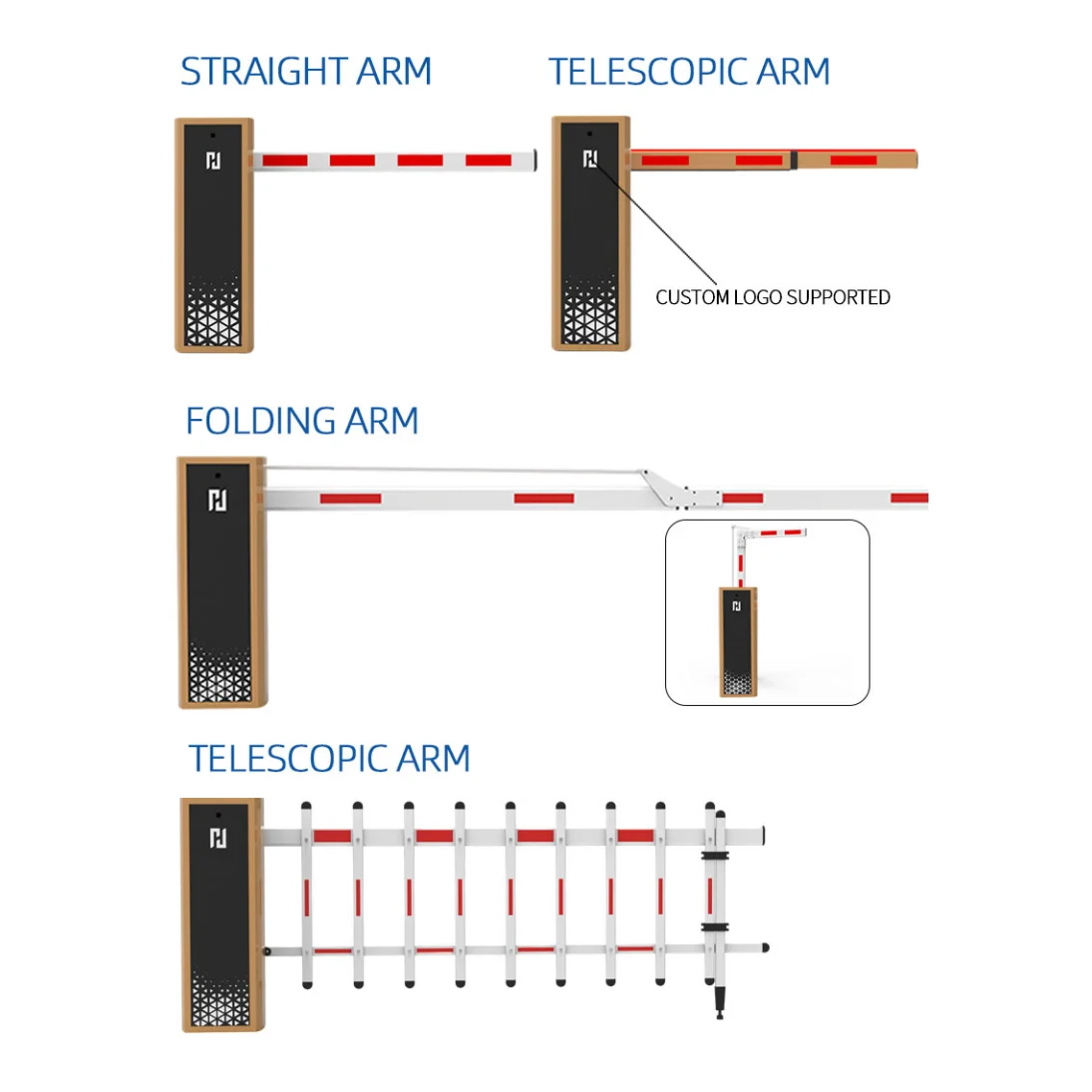
Next, check the complete movement envelope of the boom arm. A conventional straight arm rises through a large vertical arc and may be unsuitable where the ceiling is low. An articulated folding arm changes its geometry as it opens, allowing the arm to operate within a more restricted overhead space. BAROXON lists folding-arm options, including 90-degree and 180-degree configurations on selected models; the correct arrangement must be confirmed against the exact product drawing and site dimensions.
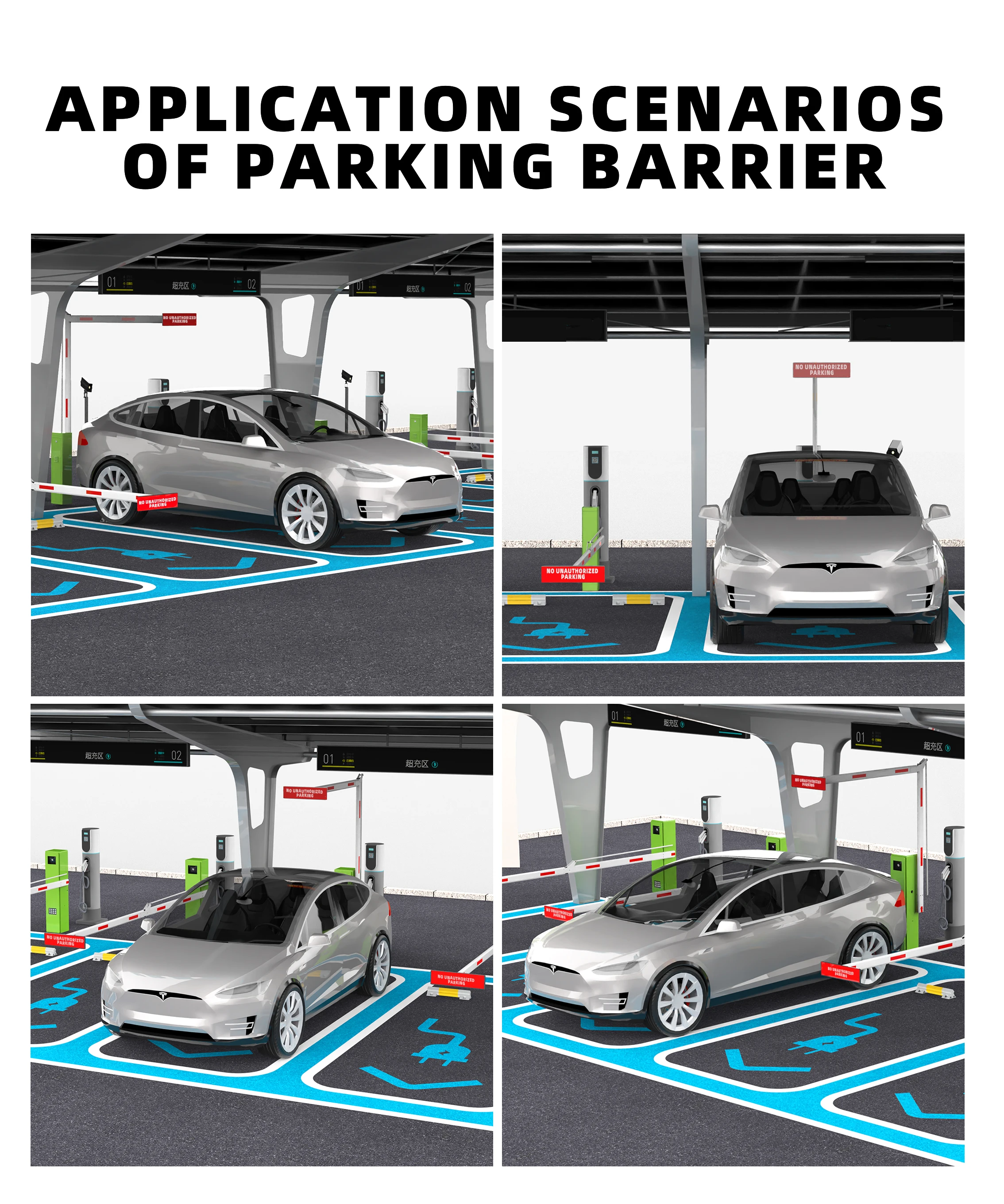
Before ordering, request a dimensioned drawing showing the cabinet position, pivot point, arm length, folded profile, fully raised position and required clearance. Check both the opening and closing movement, not just the parked position. Allow for installation tolerances and any future ceiling-mounted equipment.
2. Decide Whether a Folding Arm or Straight Arm Is More Suitable
A straight boom arm is often a practical choice where the entrance has sufficient vertical clearance and a clear lifting path. It has a simple profile and can suit many standard car park lanes. However, a straight arm may conflict with a low beam, suspended services or a steep ramp profile.
A folding or articulated arm is worth considering when the boom must clear a low ceiling or overhead obstruction. Its hinged sections allow the arm to fold during operation. The folding angle, arm length, joint position and cabinet orientation all affect the clearance envelope, so do not assume that every folding arm will fit every basement entrance.
| Entrance condition | Configuration to assess | Important checks |
|---|
| High ceiling and clear lifting space | Straight arm | Lane width, arm length and vehicle detection |
|---|
| Low ceiling or overhead beam | Folding / articulated arm | Folded profile, joint clearance and movement envelope |
|---|
| Tight turning approach | Barrier position and arm orientation | Vehicle swept path and cabinet protection |
|---|
| Wide or multi-lane entrance | Project-specific barrier layout | Lane separation, control logic and safety coverage |
|---|
| Steep ramp | Site-engineered arm and detection layout | Ground clearance, stopping position and visibility |
|---|
3. Assess the Ramp Gradient and Vehicle Approach
Underground car park entrances frequently combine a ramp, a change of gradient and a short level area. These features affect where a vehicle can stop safely and where the barrier should be installed. A barrier placed too close to a slope transition may leave insufficient space for a vehicle to stop, while a poorly positioned cabinet can reduce the usable lane width.
Map the approach path for cars, vans and any larger vehicles that use the facility. Check the driver's sightline to the barrier, the available queue length, the distance from the public road or internal circulation route, and whether a vehicle can wait without obstructing pedestrians or other traffic. Where the entrance is curved, confirm the swept path rather than measuring only the kerb-to-kerb width.
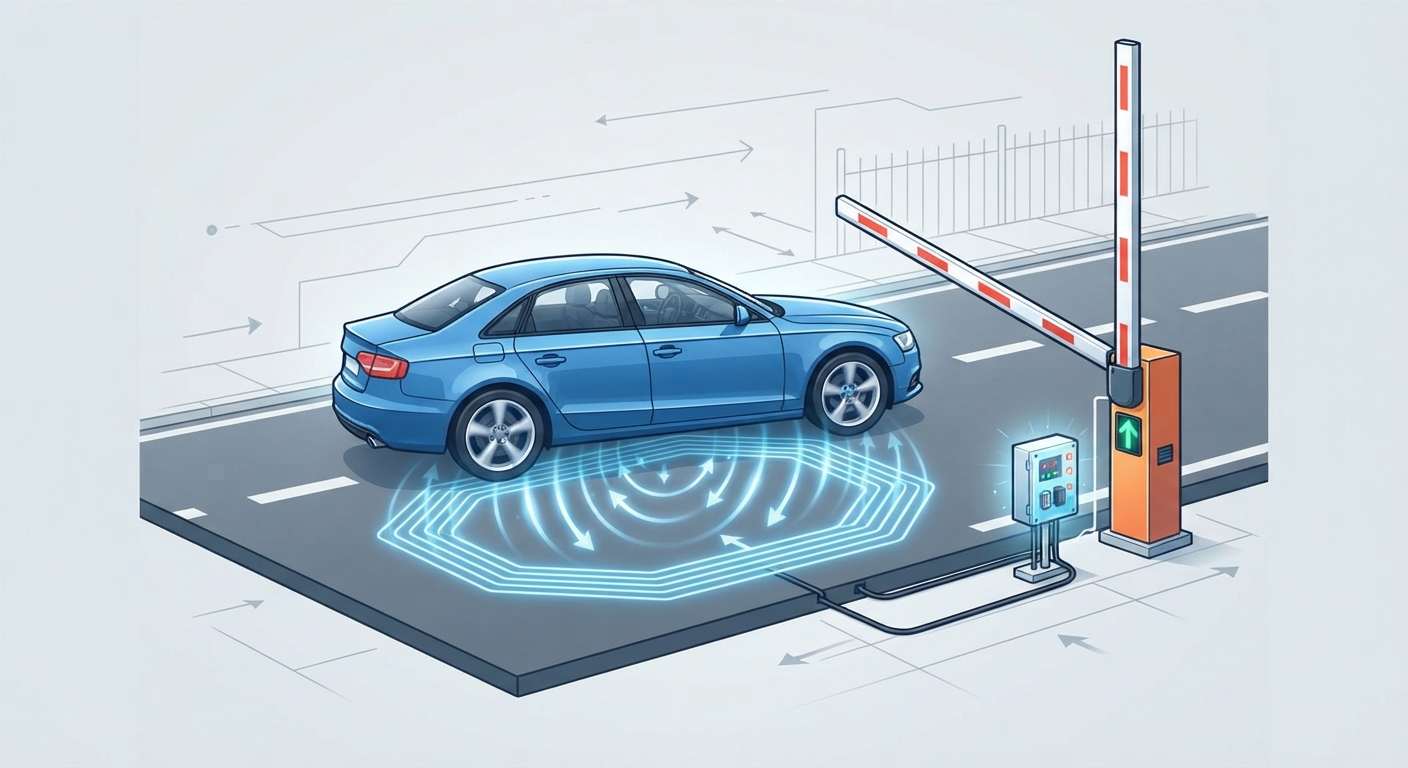
For sloping entrances, review the position of vehicle detection loops or other sensors with the installer. The detection sequence should allow the barrier to respond to an authorised vehicle while helping prevent the arm from lowering onto a vehicle beneath it. Sensor placement and control logic must be designed for the actual lane geometry and validated during commissioning.
4. Choose a Drive System for the Expected Traffic Pattern
Estimate how many vehicles use the entrance on an average day and during the busiest hour. A residents-only basement, a mixed-use development and a public underground car park can have very different traffic patterns. Include visitor movements, delivery vehicles, service access and any peak periods after work or during events.
Match the motor and drive assembly to the expected operating frequency, boom length and arm type. BAROXON's European product information lists different drive options, including 24 V DC brushless and other motor configurations on selected products. Motor type alone does not determine suitability: the controller, gearbox, balancing arrangement, arm load and declared duty rating must be assessed together.
Ask the supplier to confirm the permitted duty cycle and recommended operating profile for the exact model being quoted. Do not treat a maximum daily-cycle figure shown for one configuration as a guarantee for the entire product range. If the car park operates continuously, request written confirmation that the selected motor, arm and controller combination is suitable for that duty.
Plan Safety Detection for Vehicles and Pedestrians
Safety is especially important in a basement where visibility may be reduced and vehicles may approach on a slope. Consider the combination of vehicle loops, photocells, radar or other compatible detection devices. The appropriate arrangement depends on the controller, lane layout, vehicle direction and the risk assessment for the site.
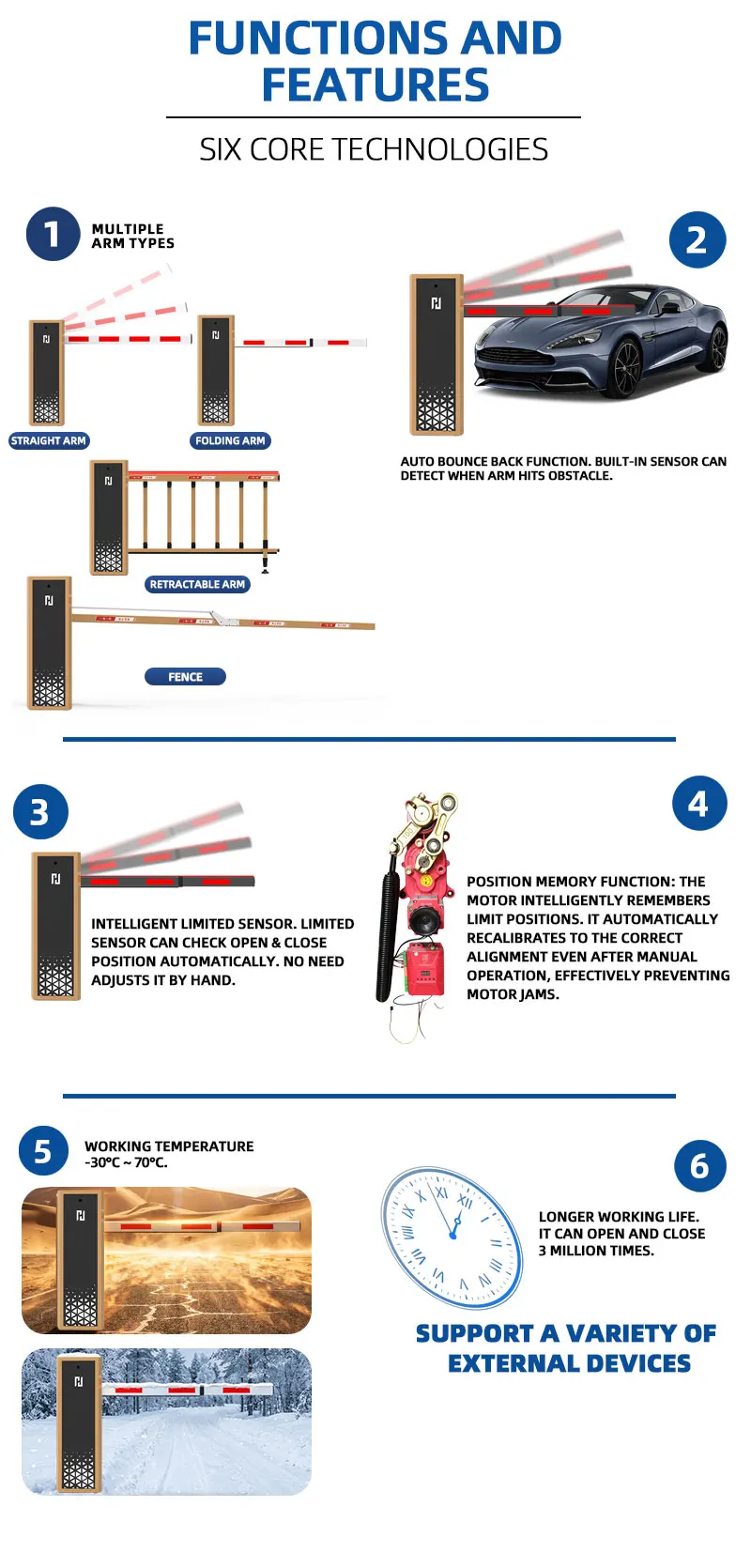
Confirm what happens if a vehicle stops beneath the arm, reverses, follows another vehicle too closely or approaches while the barrier is closing. Ask the installer to demonstrate the safety logic, including any automatic rebound or stop function supported by the selected controller. Never assume that a sensor is included as standard or that a feature listed for another model is available on the chosen configuration.
A vehicle barrier does not replace a properly designed pedestrian route. Provide a separate, clearly marked walkway wherever people need to enter or leave on foot. Keep the cabinet, boom movement area and service access clear, and coordinate the barrier installation with lighting, signs, mirrors and the site's fire and emergency arrangements.
6. Select an Access-Control Method That Suits the Car Park
For residential underground parking, RFID cards or long-range vehicle tags can make regular entry convenient for residents. A visitor intercom, PIN keypad or remote authorisation process may be added where the operator needs to manage occasional access. Choose a method that fits the number of users and the way credentials are issued, suspended and replaced.
For public or managed car parks, ANPR/LPR camera recognition may support ticketless entry, registered-vehicle access or integration with parking-management software. BAROXON's European product information describes options for RFID, licence plate recognition and parking-system integration. Confirm the supported interface, communication method, trigger sequence and software responsibility with the barrier and system suppliers before installation.
Before choosing a camera-based system, assess lighting, camera position, plate visibility, vehicle stopping distance and the network connection. Underground entrances can have challenging lighting transitions between daylight and artificial illumination. The camera and software should be tested at the actual approach angle and with the number-plate formats used at the site.
7. Check the Cabinet Location, Environment and Installation Space
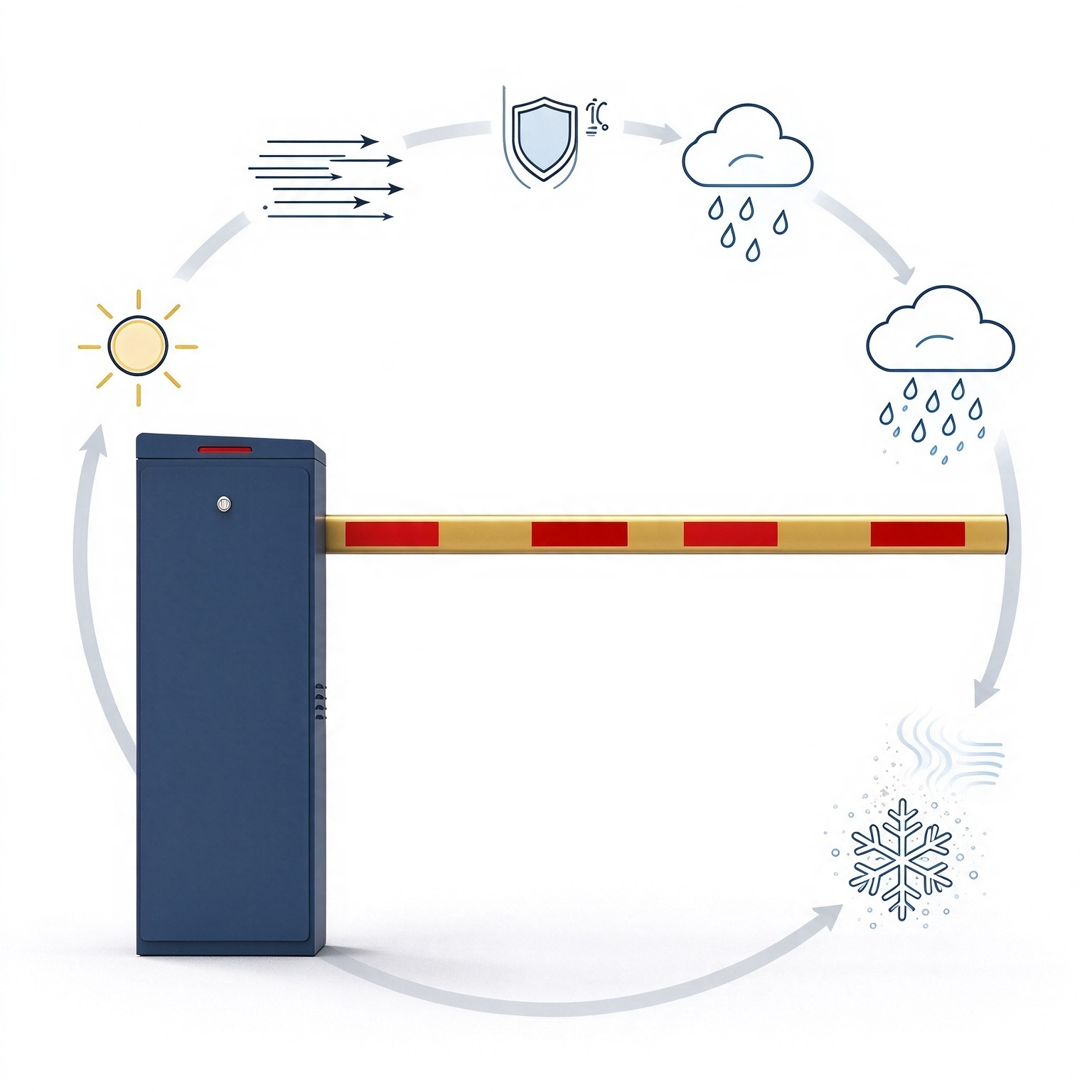
Underground does not always mean dry or dust-free. Water can enter through ramps, drainage channels or vehicle movement; condensation and cleaning operations may also affect equipment. Identify the likely exposure before specifying the cabinet and electrical protection. Check the manufacturer's stated IP rating for the exact model and establish which parts of the assembly the rating covers.
Choose a position that leaves enough room to open the cabinet for maintenance and to remove components safely. Keep the cabinet away from the vehicle's turning path and protect it from accidental impact where necessary. Plan cable routes, conduit entries, drainage and the mounting foundation before installation rather than adapting them after the barrier has been delivered.
8. Confirm Power Supply, Manual Release and Emergency Operation
Check the available electrical supply at the installation point and confirm the voltage and frequency required by the selected barrier. BAROXON's European product information includes different electrical and motor configurations; the wiring diagram and nameplate for the exact model should take precedence over general website descriptions. Have a qualified installer confirm circuit protection, isolation, cable sizing and earthing requirements in line with the applicable local rules.
Ask how the barrier can be operated if the power supply fails or the control system becomes unavailable. Confirm whether the selected model provides a manual release or clutch, how it is accessed and who is authorised to use it. The operator should have a documented procedure for securing the entrance and managing vehicles during a fault.
9. Consider Noise, Vibration and the Residential Environment
An underground car park may sit directly below flats, offices or hotel rooms. Motor noise, cabinet vibration and repeated arm movement can therefore affect occupants, particularly during early mornings and late evenings. Ask for information about the operating noise of the proposed configuration and consider the mounting surface, cabinet fixing and the condition of the boom mechanism.
A correctly installed and maintained barrier is more likely to operate smoothly. Check that the foundation is stable, fixings are secure and the arm is correctly balanced for the specified drive. Do not try to solve vibration or noise by changing controller settings outside the manufacturer's instructions.
10. Plan Maintenance and Access for Future Repairs
Maintenance access is easy to overlook in a compact basement entrance. Make sure technicians can reach the cabinet, control board, motor, arm joints and safety devices without blocking the entire car park for an extended period. Keep the installation and wiring documentation available to the facilities team.
A maintenance schedule should cover visual inspection, arm alignment and balance, cabinet fixings, cable entries, sensor operation, emergency release and the condition of moving parts. Inspection frequency should follow the manufacturer's guidance and reflect actual traffic levels, operating hours and environmental conditions.
11. A Practical Underground Car Park Barrier Selection Checklist
Use the following checklist during the site survey and supplier quotation stage:
- Headroom: Measure the lowest obstruction and confirm the full arm movement envelope.
- Arm type: Compare straight and folding configurations against the ceiling and ramp geometry.
- Lane layout: Record clear width, turning radius, gradient, stopping position and queue length.
- Traffic demand: Estimate average and peak vehicle movements and confirm the model's duty rating.
- Safety: Specify compatible loops, photocells, radar or other detection devices as required by the risk assessment.
- Access control: Choose RFID, ANPR/LPR, intercom, keypad or a suitable combination.
- Environment: Check moisture exposure, drainage, dust, impact risk and the exact enclosure protection rating.
- Electrical supply: Confirm the model's voltage, frequency, protection and wiring requirements.
- Emergency operation: Document manual release and fault procedures.
- Maintenance: Allow access for inspection, adjustment and replacement of components.
Frequently Asked Questions
Is a folding arm barrier always necessary for an underground car park?
No. A straight arm can be suitable where there is enough headroom and a clear lifting path. A folding or articulated arm is worth assessing when beams, pipes or a low ceiling restrict the movement of a conventional arm. The decision should be based on measured clearance and the manufacturer's dimensioned drawing.
What should I measure before ordering a basement parking barrier?
Measure the lowest overhead obstruction, entrance width, ramp gradient, turning path, vehicle stopping position, available queue length and the space available for the cabinet. Also record the position of lighting, signs, pipework, sprinklers and cable trays.
Can an automatic barrier be installed on a sloping car park ramp?
It may be possible, but the installation position and detection arrangement must be designed for the ramp. Check vehicle stopping distance, ground clearance, driver visibility, drainage and the location of detection loops or other sensors. A site survey is essential before specifying the final arrangement.
Can BAROXON folding arm barriers work with RFID or ANPR access control?
BAROXON's European product information describes folding-arm barrier options and access-control integrations including RFID and licence plate recognition on supported configurations. Confirm the controller interfaces, reader or camera compatibility, trigger logic and software requirements for the exact model before ordering.
What safety devices should an underground car park barrier use?
The arrangement depends on the risk assessment and lane design. Vehicle loops, photocells, radar and other compatible sensors may be considered. The installer should demonstrate how the system responds to a vehicle beneath the arm and verify the safety functions during commissioning.
What is the most important factor when choosing a barrier for a low-ceiling garage?
The most important first check is the available headroom throughout the complete opening and closing movement. A folding arm may help, but the selected model's actual dimensions, joint movement, cabinet position and installation tolerances must all be checked on the site drawing.
Conclusion: Choose the Barrier Around the Building, Not the Other Way Round
The best parking barrier for an underground car park is the one that fits the building's clearance, ramp geometry, traffic pattern and access-control requirements. In many low-headroom entrances, a folding or articulated arm deserves close consideration. However, the final decision must also account for safety detection, electrical supply, emergency operation, environmental exposure and maintenance access.
BAROXON's European range includes automatic boom barriers, folding-arm options and vehicle access-control solutions for different project requirements. Share the entrance dimensions, photographs, ramp layout, expected traffic and preferred access method with the supplier. This allows the proposed barrier configuration to be checked against the actual site before the equipment is ordered.
For current datasheets, model configuration and project support, see the BAROXON Europe parking barrier and access control range.
Frequently Asked Questions
Is a folding arm barrier always necessary for an underground car park?
No. A straight arm can be suitable where there is enough headroom and a clear lifting path. A folding or articulated arm is worth assessing when beams, pipes or a low ceiling restrict the movement of a conventional arm. The decision should be based on measured clearance and the manufacturer's dimensioned drawing.
What should I measure before ordering a basement parking barrier?
Measure the lowest overhead obstruction, entrance width, ramp gradient, turning path, vehicle stopping position, available queue length and the space available for the cabinet. Also record the position of lighting, signs, pipework, sprinklers and cable trays.
Can an automatic barrier be installed on a sloping car park ramp?
It may be possible, but the installation position and detection arrangement must be designed for the ramp. Check vehicle stopping distance, ground clearance, driver visibility, drainage and the location of detection loops or other sensors. A site survey is essential before specifying the final arrangement.
Can BAROXON folding arm barriers work with RFID or ANPR access control?
BAROXON's European product information describes folding-arm barrier options and access-control integrations including RFID and licence plate recognition on supported configurations. Confirm the controller interfaces, reader or camera compatibility, trigger logic and software requirements for the exact model before ordering.
What safety devices should an underground car park barrier use?
The arrangement depends on the risk assessment and lane design. Vehicle loops, photocells, radar and other compatible sensors may be considered. The installer should demonstrate how the system responds to a vehicle beneath the arm and verify the safety functions during commissioning.
What is the most important factor when choosing a barrier for a low-ceiling garage?
The most important first check is the available headroom throughout the complete opening and closing movement. A folding arm may help, but the selected model's actual dimensions, joint movement, cabinet position and installation tolerances must all be checked on the site drawing.
Latest News
Baroxon® | Leading Boom Barrier Manufacturer
Advanced Security Access Control and Intelligent Parking Solutions.
Company Strength
Adequate Inventory
Fast Shipping
Our Products
CONTACT US
Address: No. 2 Wanshou Road, International Innovation Industrial Park, Jinan, Shandong, China






© COPYRIGHT 2025 Baroxon® | Leading Boom Barrier Manufacturer
Point your camera here to open WhatsApp chat
Scan with WeChat to add our engineer
Chat with us directly
Scan the QR code with your phone to start a WhatsApp or WeChat conversation with the Baroxon Europe export team — quotations, drawings and lead times answered by engineers, not bots.

Contact Us
Professional Manufacturer of Vehicle Barriers & License Plate Recognition Cameras,Smart Parking Access Control Solutions for Global Clients,Reliable Barrier Gates + LPR Systems, Customized to Your Project,From residential communities, commercial shopping malls, industrial parks to highway toll stations, our matched barrier & LPR sets can realize automatic license plate identification, automatic gate lifting, real-time access records, automatic charging and remote management.